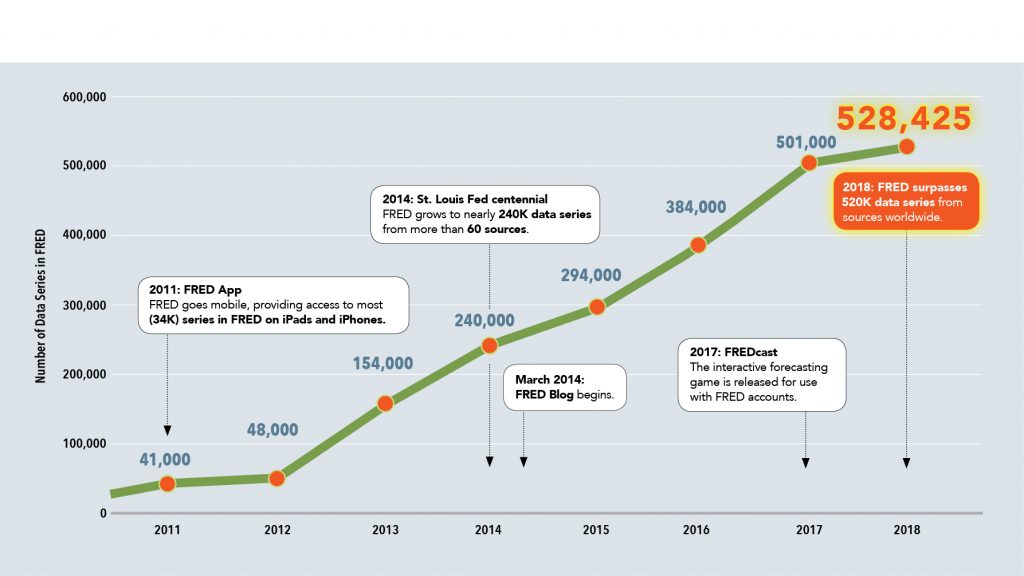
This is the 500th post for the FRED Blog, which is a great opportunity to acknowledge all those who make FRED the wonderful data tool that it is.
First, there’s the FRED team itself. These dedicated data specialists and web developers sustain and expand FRED’s structure and service. Of course, the fuel behind FRED is data and FRED’s mission is to disseminate the data. So, it’s the work of 87 data-producing institutions and agencies that allow FRED to do this—by collecting and producing data with integrity and usefulness. See the list of data producers below, but also indulge us for a moment as we acknowledge one especially effective partnership.
The U.S. Census Bureau is one of FRED’s most prolific data producers, and their data team in the Economic Indicators Division has worked closely with the FRED team to ensure all their series are in top form. The two teams share a commitment to deliver data to the public to help everyone make better economic decisions.
The Census team also promotes the FRED mobile apps in their economic indicator press releases, since they made the choice to take advantage of those FRED apps instead of creating their own. By doing so, they conserved funds and avoided duplication of effort—one example of what the two teams call “smart government.” Partnerships like this are a win-win-win for data producers, FRED, and users who need access to the data.
For a deeper dive into this world of data, take a look at the St. Louis Fed’s 2018 Annual Report, which is all about FRED and its family of data and information services. Read the essays, watch the interviews, and find out what FRED enthusiasts have to say about the importance of data access for informed decisionmaking.
FRED’S DATA PRODUCERS AND PARTNERS
U.S. Institutions and
Agencies
Research and Policy: The Federal Reserve Banks of Atlanta, Chicago, Cleveland, Dallas, Kansas City, New York, Philadelphia, Richmond, San Francisco, and St. Louis (of course) and the Board of Governors of the Federal Reserve System, including the Federal Open Market Committee; National Bureau of Economic Research, Council of Economic Advisers, Dartmouth Atlas of Healthcare
U.S. Government: Bureau of Economic Analysis, Bureau of Labor Statistics, Census Bureau, Congressional Budget Office, Bureau of Transportation Statistics, Department of Housing and Urban Development, Department of Labor, Department of the Treasury (including Fiscal Service and Internal Revenue Service), Employment and Training Administration, Energy Information Administration, Federal Highway Administration, Federal Housing Finance Agency, Office of Management and Budget, Patent and Trademark Office, Federal Deposit Insurance Corporation, Federal Financial Institutions Examination Council, Federal Bureau of Investigation, Centers for Disease Control and Prevention
Professional: National Association of Realtors, Automatic Data Processing, Inc., Cass Information Systems, Inc., DHI Group, Inc.
Analytical, Financial, Exchange: Haver Analytics, Moody’s, S&P Dow Jones, Equifax, Freddie Mac, NASDAQ, Coinbase, Chicago Board Options Exchange, Wilshire Associates
Academic: Oklahoma State University, University of California–Davis, University of Louisville’s Logistics and Distribution Institute, University of Michigan, University of Pennsylvania
International Institutions and Agencies
The central banks of England, Italy, Japan, Mexico, Turkey, Germany, Australia, and Switzerland; the European Central Bank, the World Bank, Eurostat, International Monetary Fund, Bank for International Settlements, Organisation for Economic Co-operation and Development, JP. Cabinet Office (Japan), GB. Office for National Statistics (Great Britain), Nikkei Industry Research Institute, ICE Benchmark Administration Limited (IBA), University of Groningen
Yes, there is U.S. trade with Cuba despite the embargo, as the graph above shows. The vast majority of the trade is U.S. exports to Cuba, especially since 2002, mainly in the form of agricultural goods and medication. The U.S. government relaxed the embargo for humanitarian purposes in 2000, but Cuba started to take advantage of this only in November 2001, after Hurricane Michelle. If you look closely along the black horizontal line, you’ll see there is also a little trade from Cuba to the U.S. Although it’s zero in almost every month, a few months do show Cuban exports: from a low of $2,060 (July 2009) to a high of $775,000 (August 2018). And we feel we can depend on the precision of these statistics, especially because this trade is subject to official U.S. government authorization.
How this graph was created: Search for “Cuba imports,” select the “U.S. Imports of Goods by Customs Basis from Cuba” series, and click “Add to Graph.” From the “Edit Graph” panel, use the “Add Line” tab to search for “Cuba exports” and select “U.S. Exports of Goods by F.A.S. Basis to Cuba.”
Usually, if you have the choice, you want to look at macroeconomic data that have been seasonally adjusted. This adjustment lets you compare periods within any year without being misled by the various fluctuations that occur every year. Ice cream production, tourism, and toy purchases, for example, all have predictable seasonal factors, and usually we’re interested in what happens beyond these seasonal effects.
The same logic applies to aggregate measures such as gross domestic product (GDP). But, occasionally, we just want the raw data. All three GDP components shown in the graph above consistently dip in the first quarter. In most of the country, the winter months hinder activities such as residential construction and local government infrastructure projects. As for the dip in imports, that’s linked to the dips described above, because general declines in activity are definitely reflected in imports.
How this graph was created: From the gross domestic product release, go to section 8 (not seasonally adjusted); then choose the table with real GDP, select the relevant series, and click “Add to Graph.”